
Anthony Barnett is a campaigner and author. In 1988, in the pages of the New Statesman, he helped found the pressure group Charter 88, advocating for constitutional reform. Several of its demands – including Scottish and Welsh devolution, House of Lords reform, the Human Rights Act and the Freedom of Information Act – were passed by the early Blair governments. But Barnett also has a longstanding interest in the British national question: the issue of English nationality within Britain, and the prospective “break-up” of the multinational United Kingdom that was first predicted by Tom Nairn in his 1977 book of that title. Barnett was a close friend and collaborator of Nairn, and wrote the introduction to the new edition of The Break-Up of Britain in 2021. This week, we discussed the victory of Celtic nationalism in the Scottish and Welsh elections, the rise of ethnic Englishness on the far right, and his support for Andy Burnham’s leadership campaign. The transcript has been edited for length and clarity.
Nicholas Harris: In your introduction to The Break-up of Britain, published in 2021, you write, quoting Tom Nairn some of the way, “Unless this system of government is replaced by a constitutionally articulated democratisation, Nairn foresaw an ‘unthinkable’ collapse into a hysterical, relic-seeking ‘greatness’ on the coattails of a failing America.” You also say that Nairn “saw the danger of a ‘hard-nosed and myopic’, primarily English opinion taking shape. If, he argued, it cojoined Neo-liberalism with ‘Britain’s great-power past’, and ‘if such a proto-nationalist mythology does indeed become the matrix for popular heartland resentment at decline and loss, and is further aggravated by failure or marginalisation, then, of course, serious problems could be posed’.” I thought this was a pretty good description of the Reform phenomenon we’re seeing today.
Anthony Barnett: First of all, I want to say that what we need now is a democratic English patriotism. An expression of our nationality that is welcoming and inclusive and takes on a pluralist political form. Without this, Englishness will be captured by an Anglo-British nationalism driven at its core by an English racism, that was initiated by Enoch Powell at the end of the Sixties.
Now, with Farage and Reform, we are seeing the transformation of the historic conservative tradition as it is sucked into a Reform-shaped bottle. The only way to prevent it from seizing the government in the next election is, it seems, by the immediate implementation of proportional representation, telling everyone, “We want to empower your vote.” We’re facing a form of fascism. In such a conflict never assume the enemy will make mistakes that will allow you to win. You have to assume the other side will concentrate all the forces they have. The Daily Mail, the Sun and the Telegraph know they lost the 2024 election because the Tories and Reform were divided. They won’t want to let that happen again. They’ve got two or three years to get their act together. We must assume they will. In which case, if Labour, the Greens and the Lib-Dems go into the election under our current winner-takes-all electoral system, the winner will be Farage.

So, the local election results didn’t surprise you?
What surprised me is the very slow but real sense on the left that we have to do something about our democracy. I think the penny is dropping, not in the official Labour Party at the moment, but with the Greens, and with Andy Burnham. There’s the beginning of a recognition and embrace of these arguments, though it may be too late.
How did the rest of the election results fit into the break-up thesis?
The national question is about who we are and what is our home and country. It is linked to the democracy question, and therefore to the constitutional question. The hip bone is connected to the thigh bone connected to the knee bone.
Let’s start with what I call the Anglo-Brits, who are something like 95 per cent of your readership. They do not want to think about the English question. They think that nationalism takes place somewhere else: the Scots, the Irish, now the Welsh. Wrong! It’s the English who have a national problem. It was the English that drove Brexit. What I call in The Lure of Greatness, “England without London”, where every region voted for Brexit. Brexit was driven by a frustrated Englishness which wasn’t allowed to articulate itself as English. It was a stupid but very brave “up yours” to our rulers. Brave because our rulers deserved it, stupid because the problem was not the EU but here at home. Thus England is the only major nation in the world without any representative body to safeguard its interests. The historic nature of the May elections is that it surrounded England with benign nationalist governments. Now we Anglo-Brits must emulate them and rescue England politically, and let our country in all its diversity speak for itself. That’s exciting and positive. How do we achieve this? This is now a question for anybody who’s progressive, from the liberal or centre-right through to the left.
And how do you do that, given that this disarticulated Englishness is already so developed in the form of the feeling behind Brexit, which has now transferred itself into Reform, and then also with the flagging phenomenon across the country? A different form of nationalism is already quite rampant, so how can the left catch up?
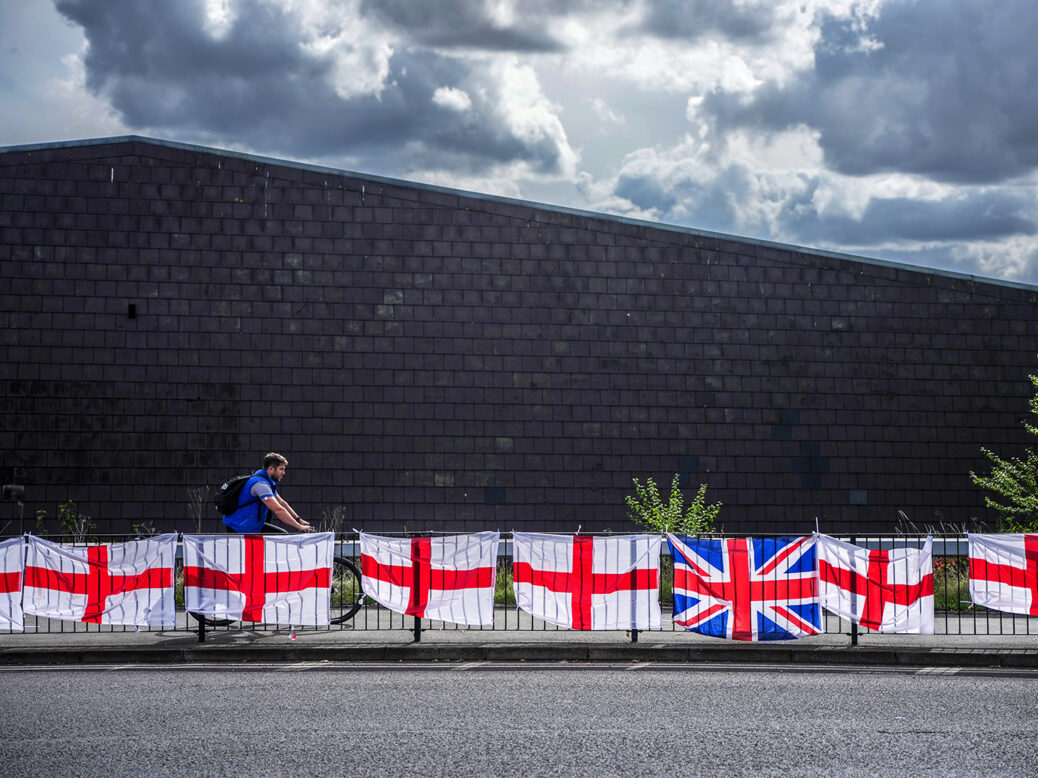
Well, I don’t look at it like that at all. I think that those guys are absolutely trapped in the Anglo-British problem. They put up a load of English flags, and then they think, “Oh, this is separatism.” So they put up a lot of Union Jacks alongside it. Why both? They want to raise the flag, but actually they’re still reprocessing in an ever-diminishing field of what you might call “British greatness”, which is represented in the Union and goes back to the origins of colonialism and imperialism. So they are not being honest about England – a country occupied by Britain, by a British state, which is highly centralising, and regards us as a native problem. And the moment you say, “Let’s move away from that, let’s liberate ourselves from Westminster,” you become a European country. Raise the flag of England on its own, and we become a normal nation whose home is in Europe. In other words the Union Jack plays the role of confining England inside an imperial tradition where it can be pressed into a racist, exclusionary project.
I think there is a fear on the left that without the cosmopolitanism of Britishness, all you will unleash is a nativist form of Englishness.
Whereas it’s the opposite. You wrote, in your piece on Larkin, that only in London and its economic annexes do you truly retain the sense of Britain as a country with international interests. Which means that everywhere else “Britishness” creates a sense of nativism in us, the opposite of cosmopolitanism.
There are two deep issues for those of us on the left about the national question. The first is the argument originally made by Tom Nairn in “The Modern Janus”. We may think that capitalism determines the economy as a universal system of exploitation and therefore nationalism is a kind of false consciousness used by capital to trick people into a false loyalty to those who are actually exploiting them. In this view nationalism is an ideological superstructure. In fact, the nation state and nationality are integral part of capitalist economic development. You can’t have one without the other. Capitalist economic development necessitates a legal system, an education system for workers and the middle class: the state creates the market. Marxism, in 1848, at its origins, got it wrong when it called on “workers of the world” to unite as if they have no real national interest, only the interest of the working class.
I’m compressing an argument. Nairn symbolises it by saying 1914 defined the reality of the 20th century, not 1917. In the Great War, the French, German, British working classes did share interests with their capitalist classes, who were equally subject to nationalism. He saw uneven and combined development as inescapable – and also depressing as it means that capitalist development is intrinsically linked to the madness of war. Nationality is an unavoidable, material force, that shapes the world and is intrinsic to our socio-economic development.
Secondly, there’s a very special aspect of Anglo-British nationalism, which comes from the historical nature of England. We created industrial society. We were “the first-born”. Other countries then had to compete to equal us. They had to mobilise. They needed flags. Germany, most obviously. We didn’t. This was was our privilege. The irony of English people today saying they don’t “feel English” is that it is an expression of English primacy. Saying, “I don’t feel English,” is English nationalism. In no other country do people deny their nationality.
We’re publishing this on the day of the Tommy Robinson march in London. What do we do about the fact that Englishness is being increasingly ethnically defined and there’s a renewed interest in an imagined Anglo-Saxon ethnic lineage? What do we do about the fact that it’s being defined on those terms on the right?
Ridicule. Share our wonderful English heritage going back to Daniel Defoe in 1707: “A true born Englishman’s a contradiction, / In speech an irony, in fact a fiction. / A banter made to be a test of fools, / Which those that use it justly ridicules… How shall we else the want of birth and blood supply? / Since scarce one family is left alive, / Which does not from some foreigner derive.”
But what do you do about the fact that people don’t agree?
Well, imagine there actually is an English parliament, or an assembly selected by fair sortition. Or look at England’s football team. We, in our diversity, are the English. People can only disagree while we are deprived of any English assembly which actually represents us. People can go around saying the English are white, but it’s a nonsense. It’s not an expression of reality. It only thrives when there is no manifestation of reality.
Are you still optimistic about resolving that institutional question, given how the language of these things has degraded so much, after the riots and so on?
The language is a grave risk to democracy. Look at Elon Musk’s tweets and his corruption of X. His is a constant, overt and blatant racism that proclaims violence is coming. This is quite new. He and his platform are driving, funding and incentivising people to the rally. We must not surrender the field and say, “No, no, we’re all British, and the British are nice and multinational, and the English are horrible and white.” Do that and you’ve handed over the country to Farage and surrendered your native land. That’s my message to the Anglo-British.
How does Englishness function in a European context?
The European continent is our home. The flaws and crises of the European Union, and there are many, are our flaws and crises. And our fellow Europeans want us and need us. People look on the European Union as fixed and oppressive. In fact it’s extraordinarily inventive and developing. The crucial thing is not to treat it in a transactional way, as something foreign from which we can benefit or not. Scotland understands itself as a European country and England can too.
We could see a more civilisational identification with Europe now, given Starmer is pivoting on Europe, and given the break with America in the last six months.
Starmer’s so-called turn, in his Monday (11 May) speech after the local election results, enraged me. He was elected on a manifesto that committed him to “make Brexit work”. When I read it in 2024 I knew Starmer was doomed, because you can’t “make Brexit work”, any more than you can have a better car crash. Anyway, that’s what he set out to do. Now he makes a speech saying, “Farage said it would make us richer. Wrong – it made us poorer. He said it would reduce migration. Wrong – migration went through the roof. He said it would make us more secure. Wrong again – it made us weaker. He took Britain for a ride.” As if he Starmer had nothing to do with Brexit, or promising to “make it work” for the last two years! Years when Starmer, not Farage, was actually in power in Downing Street. Had he said, “I tried to make it work for two years and it doesn’t,” that would have been credible, and refreshing. Instead, he takes no responsibility for his own government and his own commitments. Then, to top it off, he proclaims he will put Britain “at the heart of Europe”, a phrase of the Major and Blair years, because we share interests, values and enemies. How shared is that when he won’t let us join the customs union or the single market, let become a full member. With none of these we can’t possibly be at the heart of Europe. Who is taking who for a ride here? I felt a kind of loathing watching the speech. How can he say this to us? It’s really revolting. He has made people enraged with him to the point of hatred because he takes us as fools.
I don’t think there is any way that the European Union will accept a transactional return. They’ve had that, and we’ve had that. So we have to actually confront whether or not we are European. There’s absolutely no way that Starmer is capable of conducting that conversation.
Do you think that these elections have accelerated the break-up of Britain or slowed it down?
They have accelerated a real engagement with the question. In particular, the election of two Green candidates to the Welsh Senedd, now under a historic Plaid government, could prove a turning point. The Welsh Greens support independence for their country. Now they are strong enough to get elected the least they can do is declare independence as a party. If they do, then the Greens in the London parliament become The Green Party of England. For the first time ever there will be a real English party with MPs. Furthermore, one that can draw on the historical and literary depth of Caroline Lucas’s book Another England. A growing, articulate English party politics will create a challenge all the others will need to confront, rather than dismiss, and finally change the conversation
There are two acceptable democratic options in the long run. One is a federal Britain, where the Scots and the Welsh – Northern Ireland is different because its status is already agreed by international treaty – and the English concur on a shared constitution, in which the membership is freely made and can be freely undone, a proper federal relationship. And we all join the EU as Britain.
The second is that Scotland and Wales become independent, and we all rejoin the European Union independently. There’s no prospect of Scotland or Wales being on their own outside of the EU, nor England in my view. What would be intolerable is for Britain to become a prison of nations policed by England. Farage, having originally played an English card, is going to double down on doing just that. He will attempt to unwind all of the reforms I was associated with, the Charter 88 reforms, that New Labour implemented but failed to consolidate, from Freedom of Information and Human Rights, to the parliaments in Scotland and Wales. I warned Blair directly in 1999 that if he refused to integrate the reforms into a new constitutional settlement, he’d open the door to Euroscepticism. Alas, this is what has transpired. It’s much worse than I expected back then. But it is not yet too late.
In terms of those organising energies – Charter 88 and political reform – do you see them in Andy Burnham’s leadership campaign? Burnham has previously voiced his support for proportional representation.
To my surprise, and delight. I was in a private Compass video conversation with Andy Burnham where he said, “I’m not going back to Westminster unless it changes root-and-branch.” I’m sure he meant it. Sincerity is essential. But in politics it is only the starting blocks. It comes from what is genuinely unique about Burnham: after ten years out of Westminster he has experienced the brutal inefficiency of the UK’s centralism, witnessed how it fails, has learnt how PR creates a much better politics and seen all this reinforced by the scandal of Hillsborough and the reward of defying and beating Whitehall. You can read this in Head North, the book he wrote with his friend, Steve Rotheram. Rotheram is now the Mayor of Liverpool and they walked out of Westminster together. Head North concludes with a call for a written constitution and in effect a German model of PR and powerful regions.
But you can’t achieve this on your own. And so far Burnham’s a bit of a one-man band. He wants to be embraced by Labour and should be, as he’s a winner. But he also has to change Labour massively, defy its corruptions and drive his convictions into reality fast. A tough proposition. So, to answer the larger question, the democratic-constitutional-national-European question, the need to forge democracy in Britain is back.
[Further reading: Britain is still breaking up]
Content from our partners



Related


Join the debate
Subscribe here to comment